
What Is Osteoporosis?
May is Osteoporosis awareness month so it feels appropriate to share a post about Osteoporosis a condition I live with.
What Is Osteoporosis?
Osteoporosis is a metabolic bone condition. The bones are weaker which means that an individual is at high risk of a broken bone from a fall or in general.
What Are The Symptoms of Osteoporosis?
Often a broken bone is the first sign of Osteoporosis. It is often known as the ‘silent disease’ as there are not really any other symptoms.
Breaking a bone is very painful. Sometimes breaking a bone can result in long-term pain and/or reduced mobility, especially, from complex breaks that need plates, pins and screws.
What Are The Risk Factors to Osteoporosis?
People of any age can get Osteoporosis.
Getting older and being a female definitely means you are at higher risk of getting Osteoporosis. Especially, postmenopausal woman their risk increases. Furthermore, so does a family history.
Osteoporosis isn’t just a condition old people get.
Other risk factors include:
- Younger people who don’t have periods.
- A low body mass index (BMI).
- Some chronic illnesses.
- Physical disability, especially those who cannot stand and walk.
Weight-bearing helps build bone which is why disabled people are at high risk of Osteoporosis.
There are many illnesses that increase your risk of getting Osteoporosis, including Complex Regional Pain Syndrome. (An illness I have.)
How Is It Diagnosed?
Osteoporosis is normally diagnosed with a bone density scan. They normally scan the lumbar spine and one hip. However, in extremely severe cases it can be diagnosed on an x-ray.
Treatment For Osteoporosis?
The common treatment that GPs and rheumatologists seem to give is Alendronic Acid. It is a tablet you take once a week; you have to stand up (if possible) for an hour after taking it and drink a lot of water. The main disadvantage of Alendronic Acid is that it only maintains the bones, or slows the rate that bone is broken down in your body, it doesn’t help rebuild bones. Alendronic Acid is a type of medication called bisphosphonate.
Teriparatide (Forsteo) injections are daily injections you do yourself. You can have up to a maximum of two years in your lifetime. They are quite expensive and funding has to be requested from the CCG (Clinical Commissioning Group). Nevertheless, they can make a huge difference as they actually rebuild bones. They are generally only used in severe cases of Osteoporosis.
Denosumab is a 6 monthly injection that you normally go to the doctors to have. It can also help rebuild bones.
Zoledronate is an intra venus (IV) infusion that is given via a canula in a day care unit. Zoledronate is also a bisphosphonate.
Romosozumab (Evenity) is a new treatment for people with severe Osteoporosis, who are at high risk of a fracture. It is administered by injections. It is currently recommended by NICE.
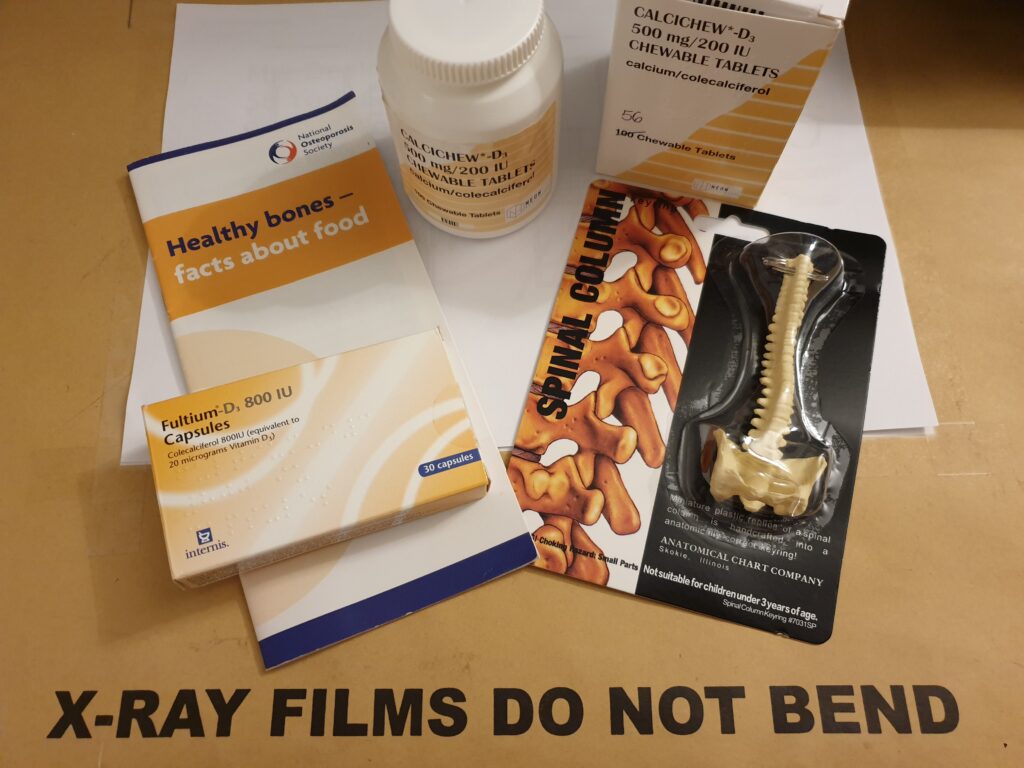
Many doctors will also put you on Calcium tablets and Vitamin D tablets if necessary.

My Experience
I was diagnosed with Osteoporosis once I had an x-ray which diagnosed a traumatic spiral fracture to my hip and femur and it had broken into five pieces. I was 20. At the same time, I think medical professionals were alarmed at how ‘thin’ my bones were diagnosing osteoporosis. I had major surgery of 5 hours. They plated my femur and put pins in and a screw through my hip to prevent dislocation.
Prior to this I had spent 4 years in hospital, 3.5 years of which I was totally bedbound. I hadn’t walked at that point for 6 years, or stood for at least 5.5 years and I was a wheelchair user.
There were many alarming factors I had: not being able to walk for years; I had Complex Regional Pain Syndrome (CRPS) (which often causes secondary Osteoporosis); I wasn’t having periods; I had a low body mass index (BMI) and a family history.
I had to have further surgery several years later to remove the metal work, rebreak my femur (cleanly), bring my hip down in the socket and rotate my femur, cut a bit of bone off and put thinner metal work, pins and a screw back in (a valgus osteotomy). This was to put my leg in the correct position, increase my movement with it and reduce the leg length discrepancy, as well as alleviate some of the pain.
My Treatment
I am lucky to have been under the metabolic bone expert Professor Keen, at the Royal National Orthopaedic Hospital (RNOH) since I was 21.
Initially I was on Alendronic Acid, then funding got approved for Teriparatide injections which I had 18 months of. I was told at 21 I was one of the youngest people to have teriparatide injections. Teriparatide injections did amazing things for my bones. Not just maintaining but actually rebuilding my bones.
Then I had several years of six monthly Desonamab injections and lastly, I had an Zoledronate infusion. The last six or seven years I haven’t had any treatment for Osteoporosis. Only regular bone density scans and appointments with my consultant to monitor my bone density levels. Your bones should still be increasing in density until you are 35, so I am lucky I have a few more years.
I have not had any falls, but it worries me if I did, that I might break a bone or dislodge my metal plate, pins and screws.
Take Away Message and Royal Osteoporosis Society Website
Let’s break the stereotype, Osteoporosis doesn’t just affect old people.
For more information, treatments etc check out the Royal Osteoporosis Society website.
Hannah x
You may be interested in reading my post: A Trip Back To Hospital, which is about the second lot of surgery I had on my hip and femur


